CelMusperOS@R
CelMusperOS@R and NR Three-Network Design
Keep complex network management and data transport inside the system, and leave the simplest possible experience to the user
Network Isolation
Why a Music Router Improves Sound Quality
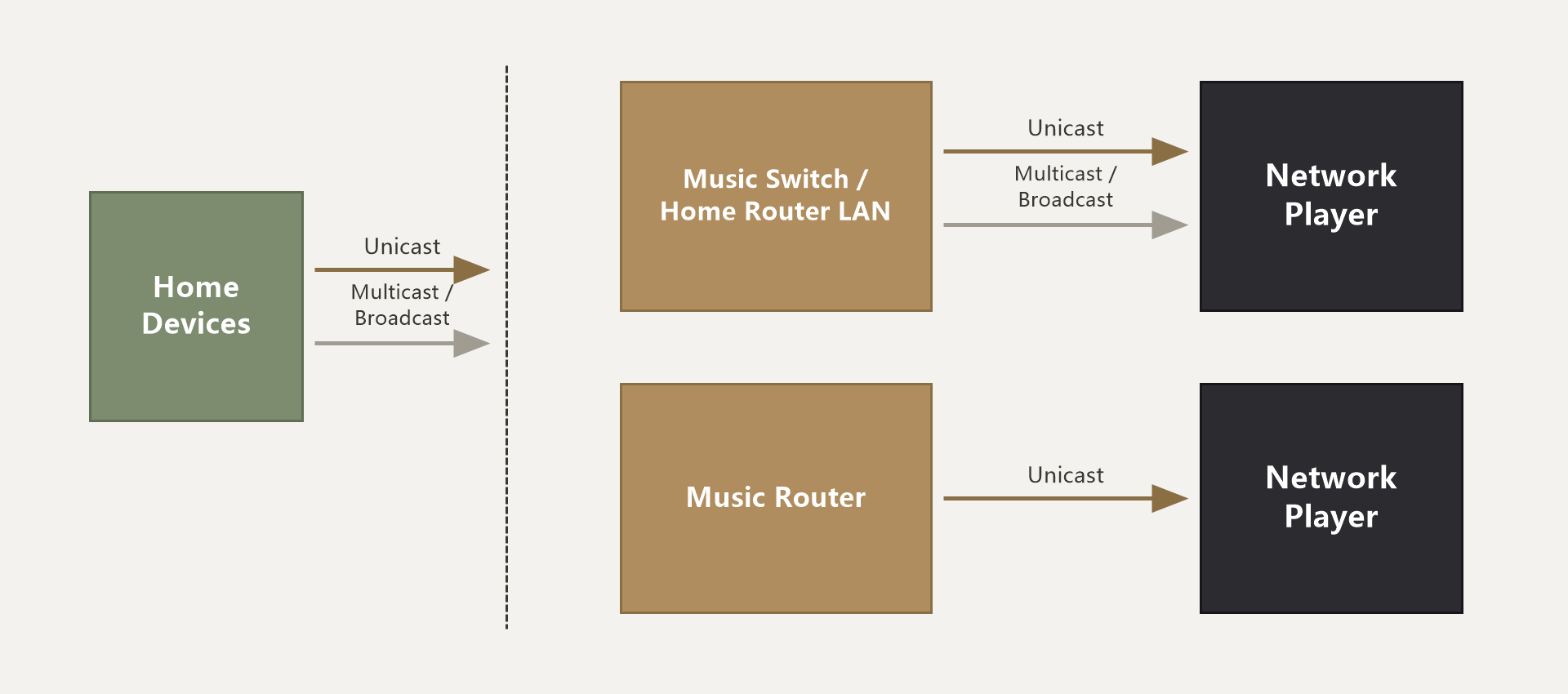
Like a music switch, a music router provides a better network foundation for music playback by optimizing the network environment. The difference is that a music router also offers Layer-3 network management that a music switch does not: it can divide the home network and the HiFi network into two relatively independent networks, keeping unnecessary broadcast and multicast traffic out of the HiFi network.
In a typical home network, besides the network player, there are phones, computers, smart TVs, NAS and all kinds of smart home devices. Beyond normal data transfer, these devices constantly generate discovery and status traffic. A phone searching for AirPlay devices, a computer browsing network shares, and smart devices discovering each other may all rely on multicast or broadcast. With a traditional music switch or the LAN port of a home router, all of this traffic is forwarded to the network where the music devices live — even though most of it has nothing to do with music playback.
From the perspective of a music playback system, the potential impact of network activity can be understood on two levels: data processing and electrical behavior. Network traffic increases receive activity on the player's network interface, adding load to the CPU and the network protocol stack and affecting the real-time performance of audio processing. At the same time, activity in the network interface and related digital circuits causes dynamic power-draw changes, altering the local power load and electromagnetic environment.
CelAudio believes that network interference actually consists of two parts: data interference and electrical interference. Through power supply design, physical layout and circuit optimization, a music switch reduces its own electrical interference and part of the external interference; but within a traditional Layer-2 network architecture, it cannot actively isolate broadcast and multicast traffic from the home network.
The NR music router divides the home network and the HiFi network into two relatively independent networks, reducing unnecessary broadcast and multicast traffic entering the HiFi network while preserving essential communication channels — providing a more independent and controllable network environment for music playback. In this way, the unrelated processing burden on the playback device is greatly reduced, and together with the NR music router's purpose-built hardware design, the electrical interference caused by network activity is further lowered.
Three Networks
Why "Three Networks"
A typical home router offers only a WAN/LAN dual-network design, but for a HiFi router this may not be enough.
In the previous example, the music router forwards only unicast traffic. But a real home environment also needs Internet access, which usually requires enabling NAT (Network Address Translation). However, once NAT is enabled on the music router, devices on the home network side can typically no longer actively reach the music devices on the other side of the router. If NAT is disabled on the music router and the upstream home router handles NAT instead, corresponding static routes must be configured on the upstream router — something most users can hardly accomplish.
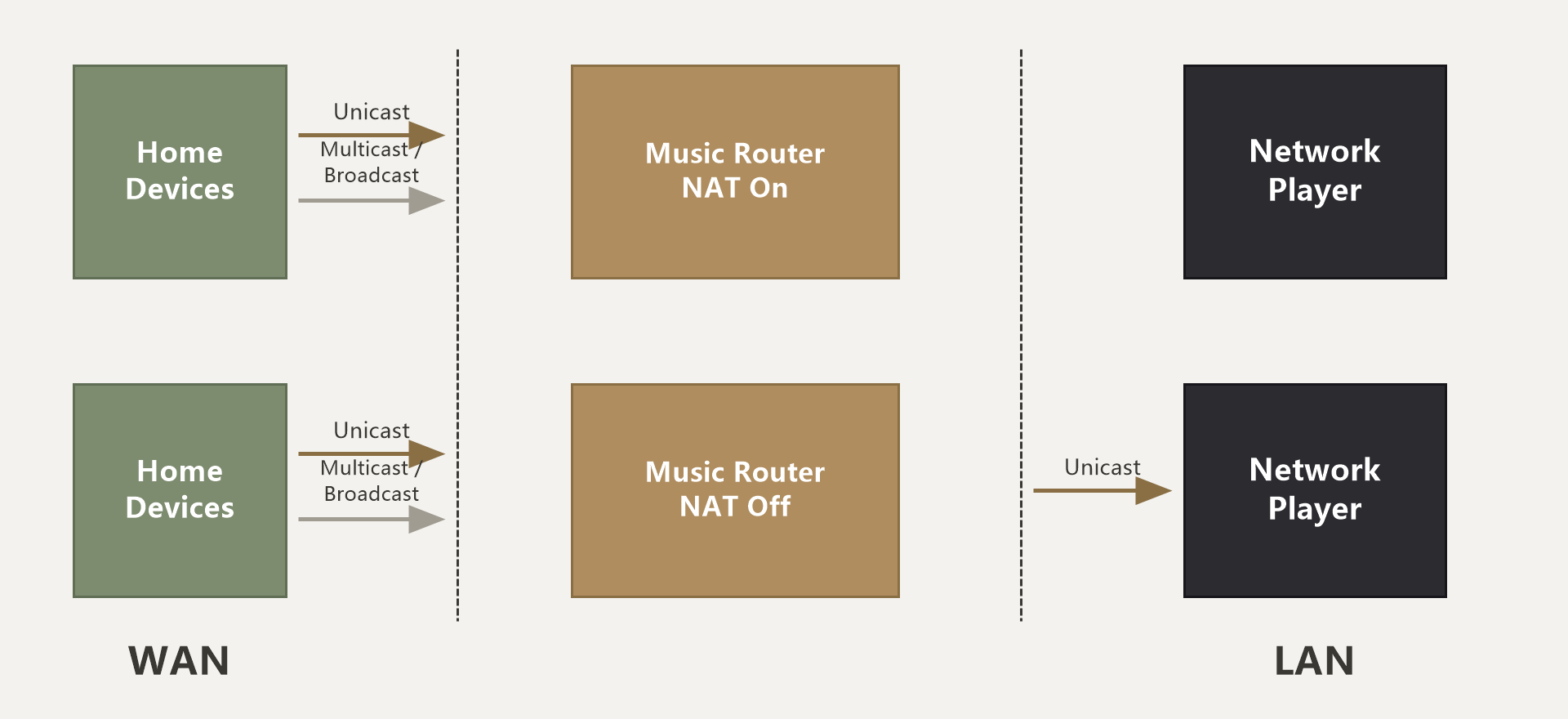
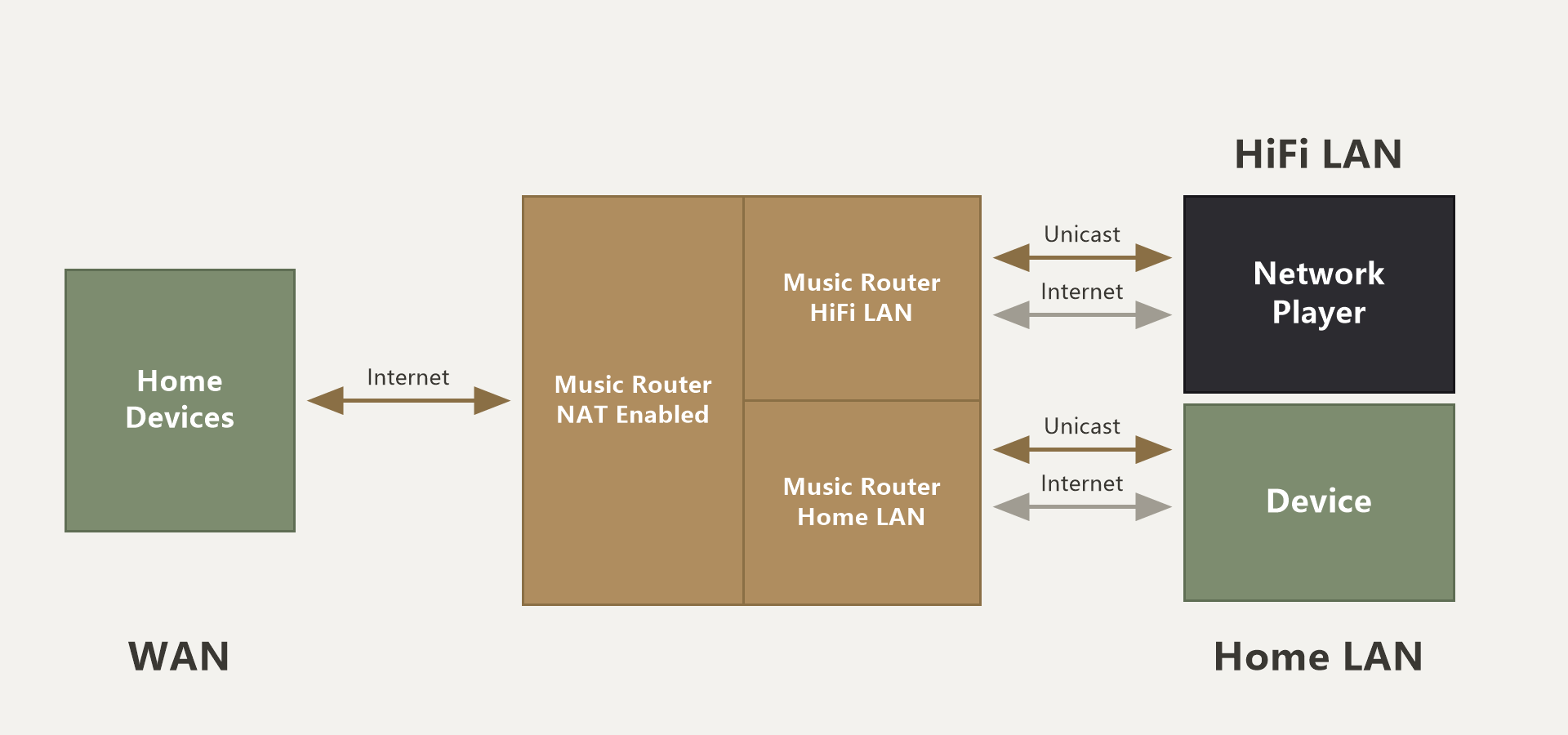
CelAudio brings multi-subnet routing — a capability usually found in enterprise-grade products — into the music router: a single WAN that performs NAT for all traffic, plus two independent networks without NAT — HiFi LAN and Home LAN. Together they form the "Three Networks".
With pre-configured routing, the networks communicate as needed without any complex setup by the user, dramatically lowering the barrier for ordinary users without router networking knowledge.
CelLink Relay
CelLink Relay: Simplicity for Users, Complexity for CelMusperOS@R
With the three networks in place, users no longer need to understand complex router configuration. The next question is how to let users discover and use the music playback devices in the HiFi LAN as easily as if they were using an ordinary switch.
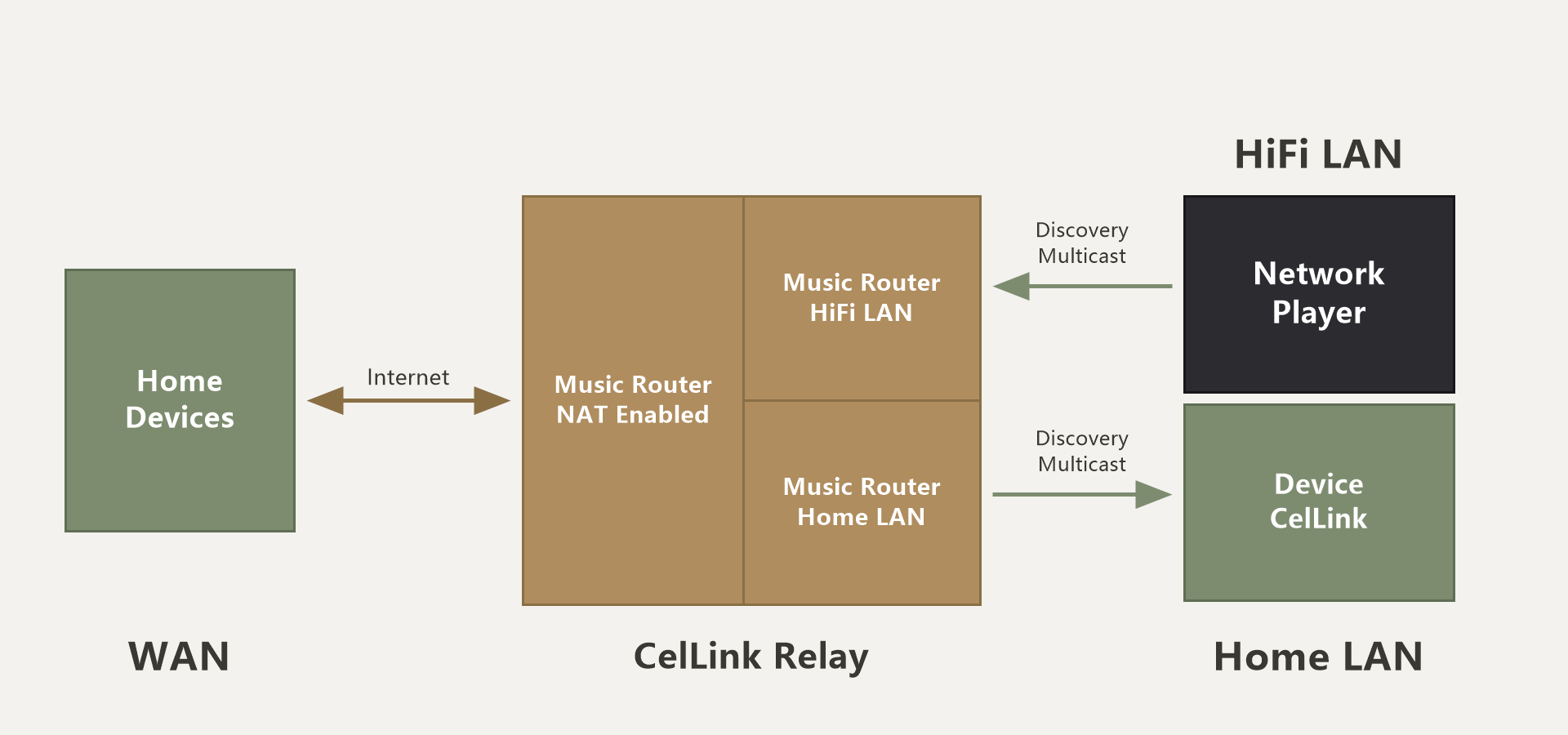
CelAudio creatively implements the CelLink Relay in CelMusperOS@R. The mDNS discovery multicasts periodically sent by network players in the HiFi LAN are forwarded to the Home LAN, so devices connected to the Home LAN can discover the music playback devices in the HiFi LAN as usual. Once discovered, the device communicates with and controls the player through the CelLink App using the standard HTTP unicast protocol.
Users can thus use the music playback devices in the HiFi LAN as easily as with an ordinary switch — without understanding cross-network discovery or performing any additional network configuration. At the same time, CelMusperOS@R itself can also be discovered and managed by the CelLink App. Users can discover both the player and the router in the same CelLink App and manage them separately through a unified, clean UI, which greatly lowers the difficulty of first-time setup.
CMSP Shaping
CMSP SHAPING: The Evolution of CelMusperOS@R
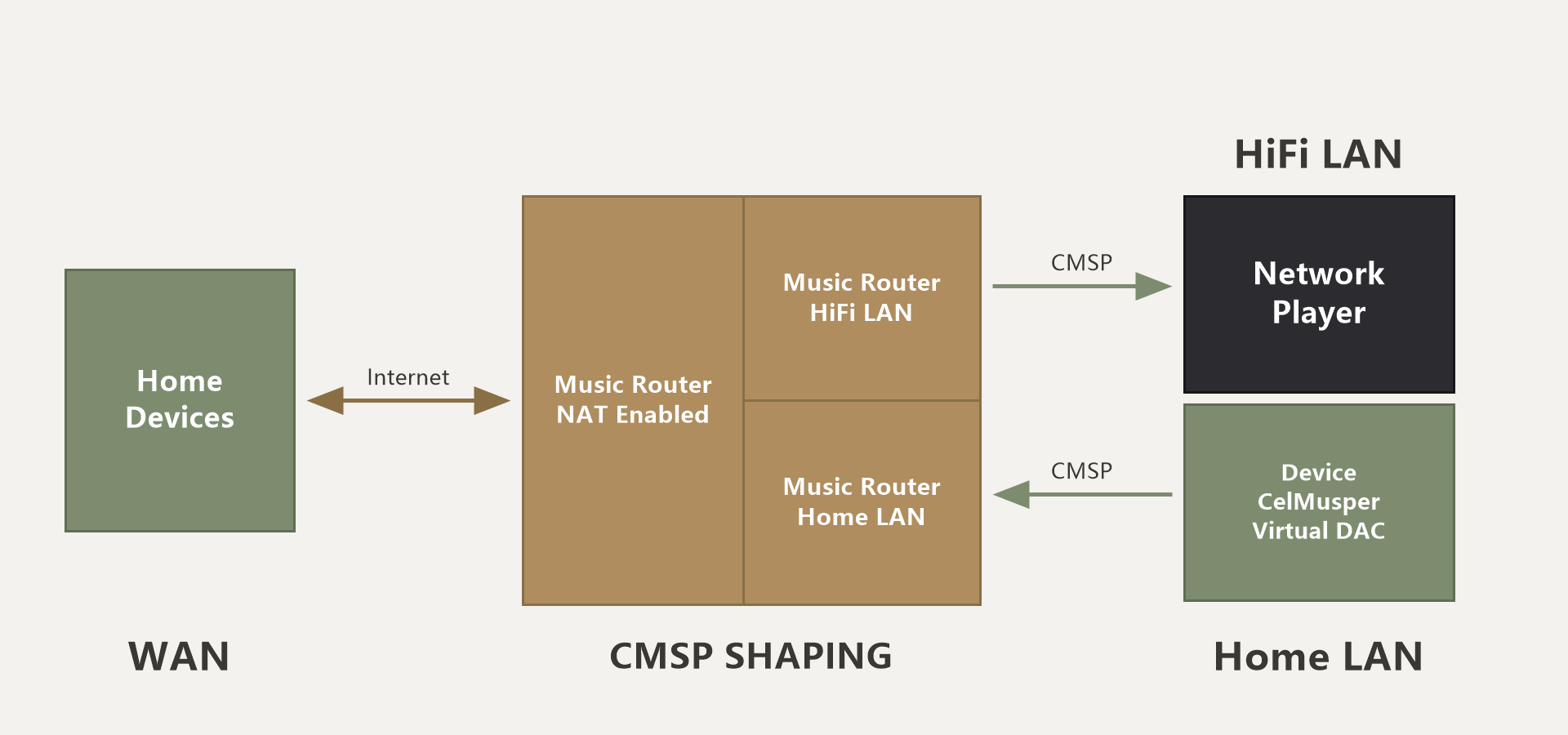
The ever-improving CelAudio Music Streaming Protocol (CMSP) keeps enriching the ways music can be played. With the CelMusper Virtual DAC installed, Windows / macOS users can send all system audio to the network player, extending the entire audio system into a sound center for gaming, short videos and video playback.
With the CelMusper App installed on a phone, Windows or macOS device, the CelMusper App can stream music data to CMSP-enabled DACs and NT/NS series products. Without an NS series music server, users can still enjoy the major music platform APIs previously exclusive to NS devices — playing music from a NAS, managing the media library, and streaming music to DACs or NT devices.
However, compared with native CMSP applications on CelMusperOS, phones and virtual sound cards are constrained by Windows / macOS / iOS / Android and cannot control the underlying network hardware and OS behavior. CelMusperOS can send network packets at a precisely fixed cadence; other operating systems can also use CMSP, but without the unified control over network interfaces and system scheduling that CelMusperOS@R has, their packet timing may be affected by the running state of the operating system.
CelAudio implements CMSP SHAPING in CelMusperOS@R: CMSP packets are automatically identified and re-sent at a fixed cadence, restoring the packet determinism that only a native CelMusperOS environment can provide. The receiving device thus gains a stable electrical behavior on its network interface, avoiding the instability caused by the uncontrolled packet timing of general-purpose operating systems.
Pure Signal. True Music.
Technology in Service of Music
From network architecture and hardware design to protocol optimization and system management, CelAudio always starts from the real needs of music playback and rethinks how network devices should work. We do not believe that more complex technology by itself means better sound. Truly valuable design means understanding the problem each technology solves, and letting those technologies work together through a sound architecture.
The NR is not only a network router designed for music playback, but also an essential part of the CelAudio music network architecture. Through technologies such as CelMusperOS@R, CelLink and CMSP, we keep complex network management and data transport mechanisms inside the system, so users can enjoy music in the simplest possible way.Learn more about the NR6 music router...
Complexity for technology, simplicity for users. Pure Signal. True Music.