Our Journey
The Journey Begins with Linear Power
Where engineering precision meets sonic artistry — redefining the HiFi network switch
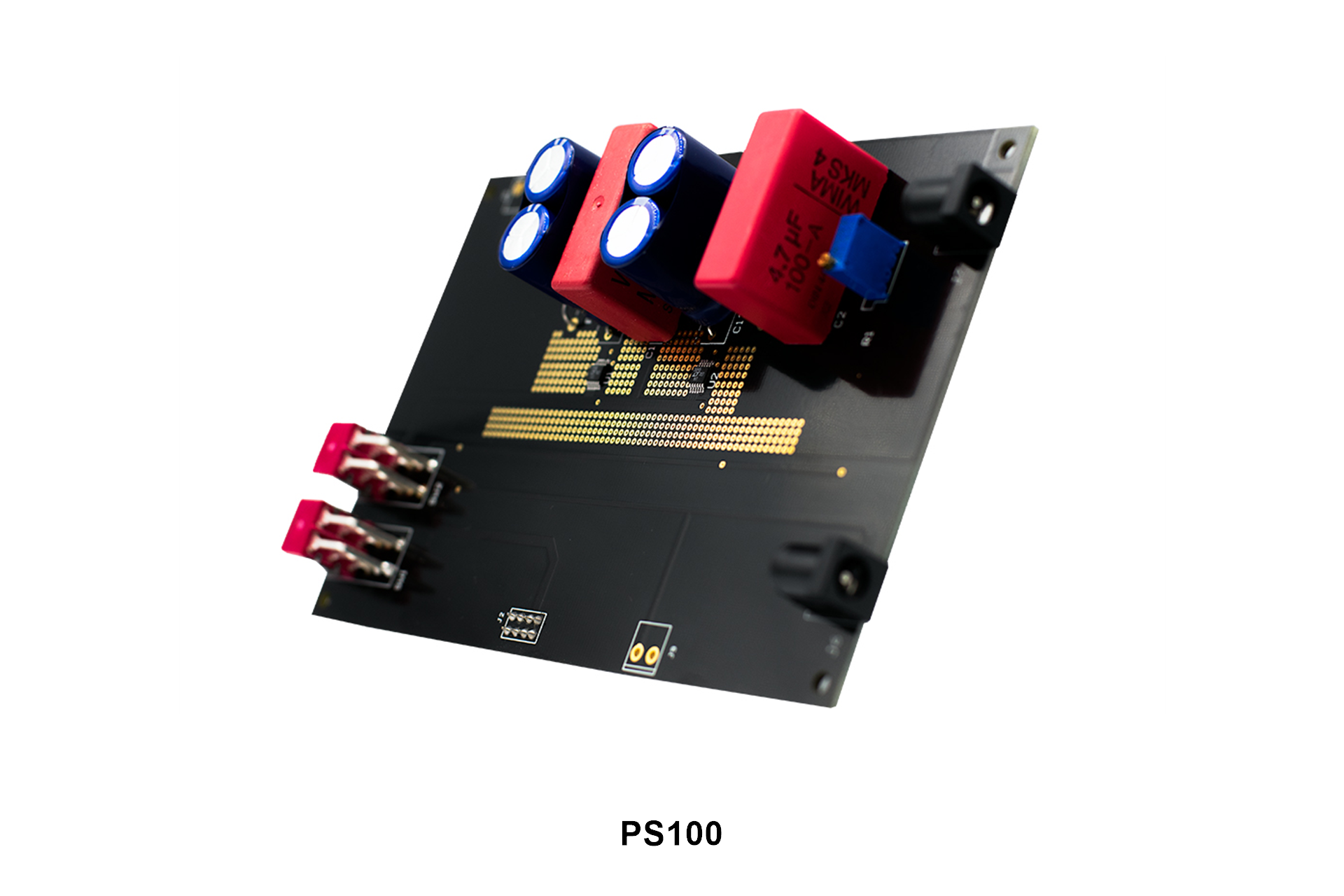
PS100: The Linear-Powered Switch Era
Founded in October 2016, CelAudio began as a specialist headphone amplifier distributor. Leveraging deep expertise from the IT industry, in 2018 we became the first to offer audiophiles a free Raspberry Pi image optimized for HQPlayer streaming — delivering USB audio performance that rivaled, and often surpassed, many dedicated high-end USB interfaces. As the impact of network transmission on sound quality became increasingly evident, we began experimenting with linear power supplies for switches and optical isolation, openly sharing our findings with the community. The PS100 marked our first step into the HiFi network audio domain.
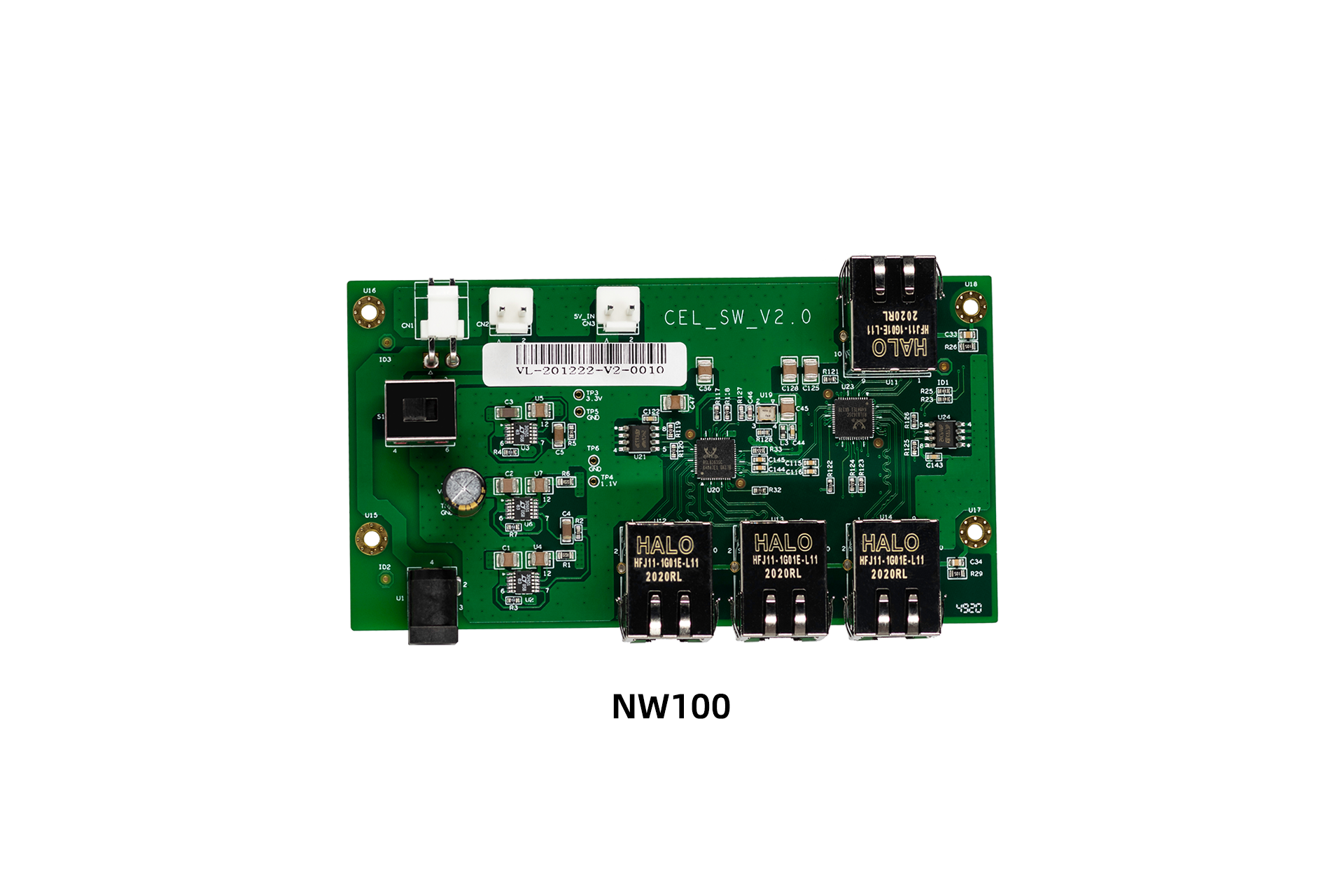
NW100: On-Board Linear Power + External Linear Power
While modifying off-the-shelf switches was the prevailing trend, CelAudio chose a different path — designing the NW100 from the ground up, the first HiFi switch with a fully linear power supply architecture. The NW100 employed LT3045 regulators to deliver 3.3V and 1.1V directly to the switching chip. However, due to architectural constraints of the era, it still required a DC 5–9V external input, making its sonic character highly dependent on the quality of the external power supply.
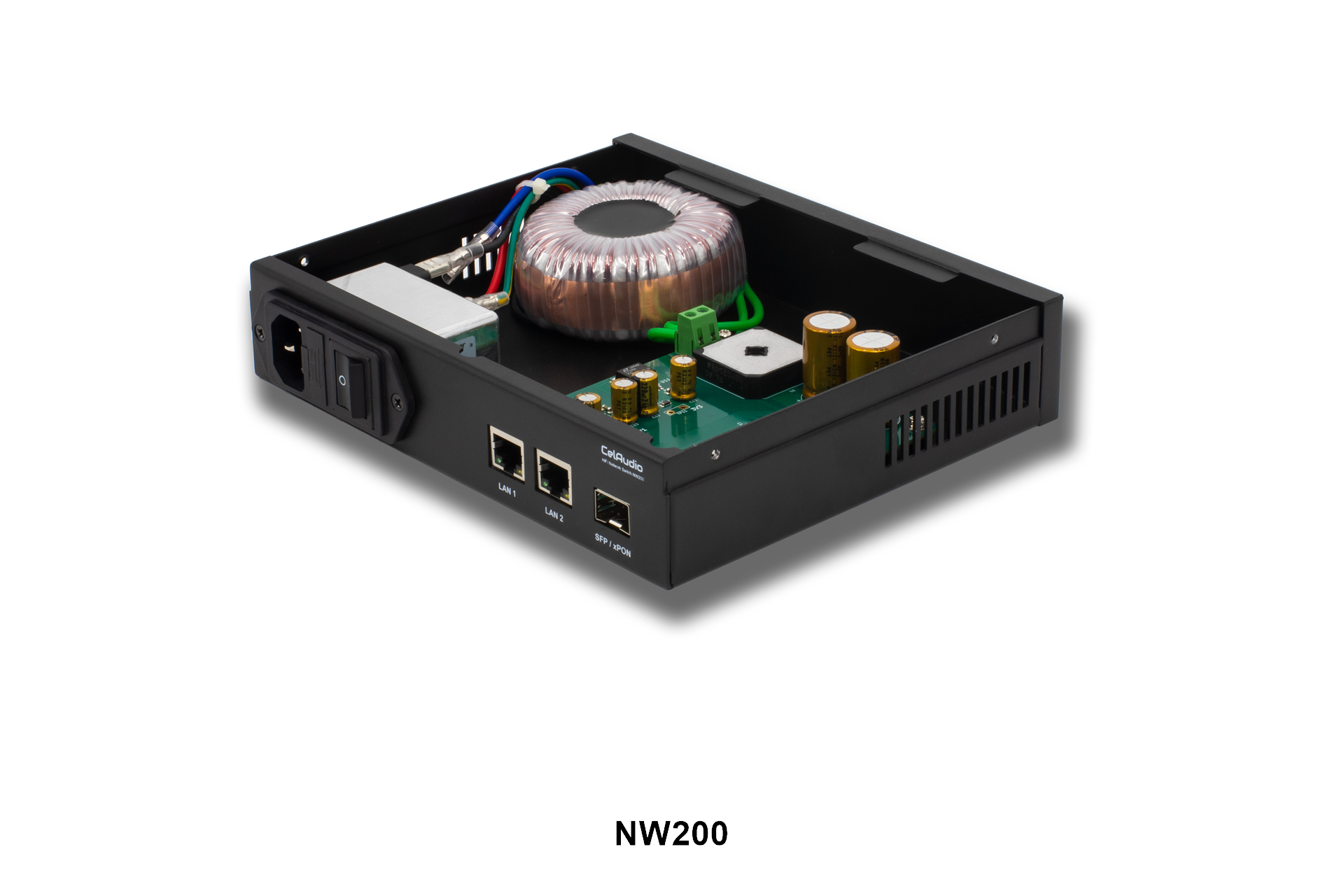
NW200: Integrated Fully Linear Power + Optical Conversion
As the HiFi community embraced optical isolation, the NW200 emerged — offering optical interfaces while being among the first to eliminate external power supplies entirely, introducing the concept of a self-contained power system. The NW200 also pioneered the use of audio-grade capacitors for sonic tuning, establishing the principle of Sonic Signature transmission.
NW300 / NW330: The OCXO Era
The NW300 introduced two groundbreaking concepts: "Sonic Signature" and "built-in high-precision clocks." It was among the first HiFi switches to integrate an OCXO and emphasize Sonic Signature tuning. Later that year, the NW330 module debuted, featuring the CelCLK II PLL system paired with a 10MHz OCXO. It also challenged the conventional wisdom of optical isolation, introducing cryogenically treated SFP-DAC cables and redefining fiber optics as a sonic tuning tool rather than a noise-reduction necessity. Experience has proven that when a switch's internal architecture is mature, fiber optics become merely one of many tuning options.

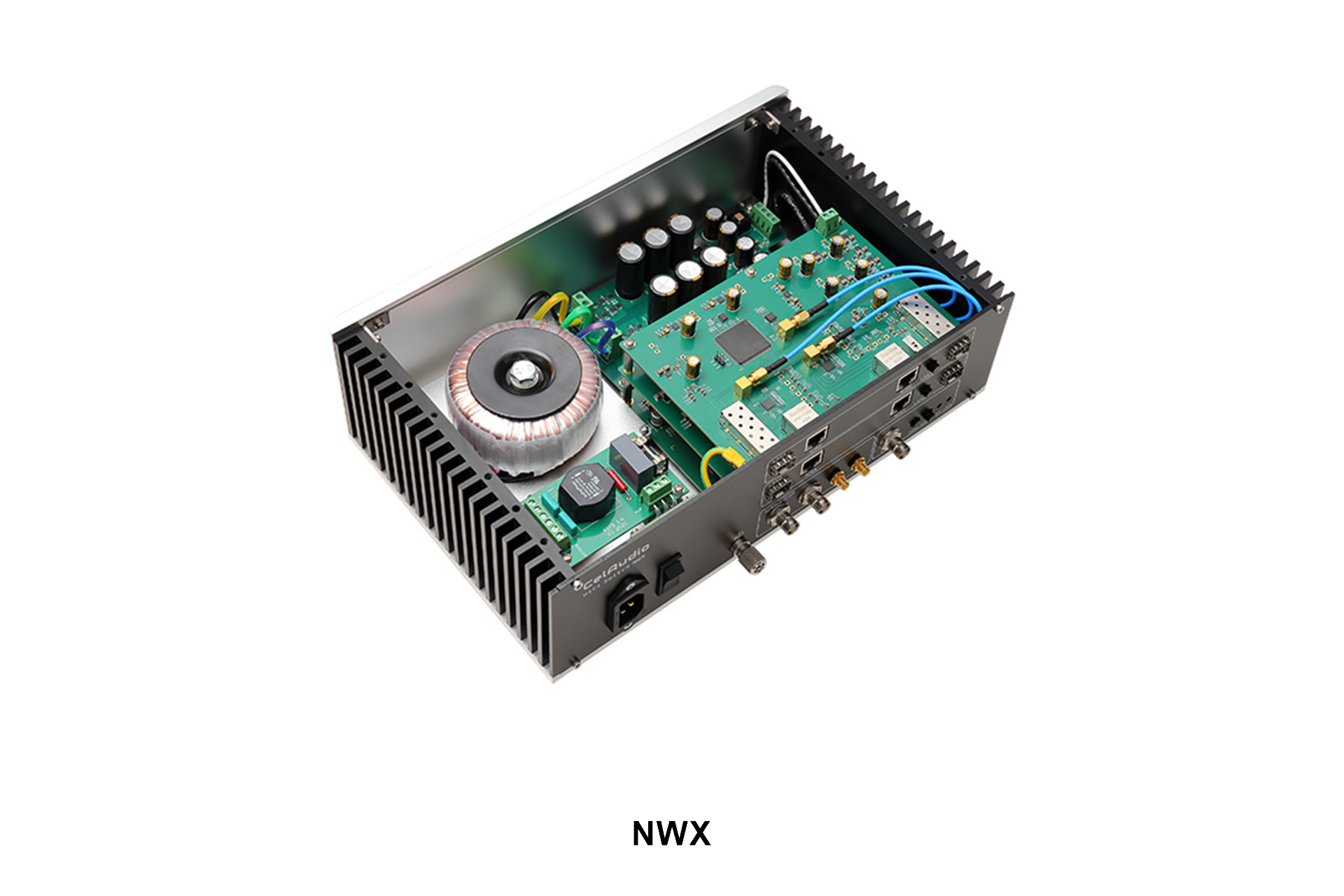
NWX: Full OCXO Clock Synchronization + Fully Linear SFP-to-RJ45
As OCXOs became widespread, we discovered that controlling the sonic impact of cascaded switches grew increasingly complex. CelAudio pioneered the concept of full clock synchronization, giving rise to the NWX. Featuring a dual-switch cascaded design with fully synchronized clocks, the NWX achieves superior sonic coherence in multi-switch setups. Furthermore, every onboard RJ45 port effectively becomes a fully linear-powered, precision-clocked "SFP-to-RJ45 interface."
Since the launch of the NW330, CelAudio's approach to HiFi switches has evolved into a convergence of technology and artistry. Through fully linear power supplies, high-precision clocks, and versatile interface options, combined with our distinctive artistic sensibility, we create HiFi switches with unique sonic personalities. No longer following trends, we treat the HiFi switch as a fundamental component of the streaming system, with sonic expressiveness as the guiding principle of our research and development.
Core Technology
Key Technologies in HiFi Switch Design
Low Noise: Excessive noise severely compromises sonic detail, degrades imaging precision, and undermines system stability. Low noise must be addressed at two levels: noise generated by the HiFi switch itself, and noise propagated throughout the home network. The core design principle is to minimize the switch's intrinsic noise while breaking the chain of network noise transmission.
High-Precision Clocks: Clock precision profoundly affects resolution and density. Generally, higher precision yields greater resolution and density. However, indiscriminately pursuing resolution can be counterproductive for mid-range and entry-level systems, as overall sonic body is not determined by the clock alone. Without sufficient body to underpin the resolution, musicality suffers. High-end systems, by contrast, typically possess ample body and can benefit from unrestricted clock precision upgrades. Entry-level systems have limited means of acquiring body, so different product tiers demand different clock precision strategies.
Multi-Switch Architecture: For HiFi switches, a multi-switch architecture is a core design element. A single switch faces inherent limitations in isolating home network noise. When connected via RJ45, network noise can propagate through copper cables, making complete elimination by a single switch nearly impossible. Optical interfaces introduce their own noise from the optical module itself — which explains the vast sonic differences between various optical modules. Therefore, a cascaded multi-switch design is a rational approach to handling home network noise. It is important to note, however, that while HiFi switches can attenuate noise, they cannot fully eliminate the Sonic Signature of upstream devices and cables; the sound remains influenced by the upstream connection. Moreover, the impact of a HiFi switch extends beyond streaming playback to local file playback on network players, where the upstream network also influences sound quality.
NW330
NW330: Sonic Signature Meets High-Precision Clocks
In 2023, the NW300 became the first HiFi switch to emphasize Sonic Signature, featuring a dual heterogeneous switch design with network isolation transformers for noise isolation. Later that year, the NW330 module was introduced, debuting the CelCLK II PLL system paired with a 10MHz OCXO.
High-Precision Clock Design: CelCLK II PLL system with 10MHz OCXO reference. Learn more about CelCLK II...
Noise Control: The NW330 employs a triple-switch architecture with fully linear power supplies, including independent power for the SFP module to maximally suppress noise from both the optical module and the switch itself. Two isolation methods are used: network isolation transformers between the LAN and isolate zones, and SFP isolation between the isolate zone and the clock switch card, effectively eliminating noise from the home network.
Sound Modes and Tuning: The NW330 utilizes a heterogeneous triple-switch design with three different switching chips. Since different chips exhibit distinct Sonic Signatures, the sonic presentation varies depending on which chip serves as the input versus the output.


NWX
NWX: Full Discrete Port HiFi Clock Switch


Full Discrete Ports and Noise Control
The NWX employs a dual-switch architecture with fully linear power supplies, including independent power for the SFP module to maximally suppress noise from both the optical module and the switch itself. Each RJ45 interface on every switch is controlled by an independent PHY chip, with dedicated clock input and independent LT3045-based power supply. Thanks to this independent per-port power architecture, the NWX achieves superior noise suppression and isolation compared to optical fiber isolation, effectively eliminating noise from the home network while minimizing self-generated noise.


Dual OCXO Clock Module
The NWX series HiFi clock switch features a clock module with a 10MHz OCXO reference clock offering -120dB@1Hz phase noise and 8e-13@1s Allan variance. The internal switch clock source — the CelCLK II PLL system — employs a separate 50MHz OCXO with -85dB@1Hz phase noise and 1e-11@1s Allan variance as the VCO reference. The synergy between the 50MHz VCO and 10MHz reference clocks achieves a 1+1>2 effect, delivering exceptional clock precision for both external clock output and internal switch operation.
* The NWX contains a single clock module. The image shows a dual-OCXO display for illustration; the actual installed module includes a clock shield.

Thermal Noise Considerations
The NWX utilizes industrial and carrier-grade switching/PHY chips, offering exceptional wide-temperature stability. Given the numerous linear power supplies and dual OCXO clocks — with OCXOs requiring elevated operating temperatures — the switch experiences significant thermal variation. The use of industrial-grade chips and extensive wide-temperature, low-drift components ensures outstanding thermal stability, guaranteeing consistent sound quality under all operating conditions.